
Stop Operators leaving their stations.

Start building a smarter material flows around them.
Every facility I tour it always seems like Material Conveyance is an after thought and in many cases nobody seems to own it. The most successful form of managing material conveyance seems to be the "HEY" system ... "hey, I need a forklift to move this pallet".
There are 2 solid methodologies to manage Material Movement. The first is the implementation of Timed Delivery Routes within your facility. Think of them as Bus Routes throughout your facility with defined stops and scheduled routes. This helps keep your operators at their stations but also helps create cadence of your operation.
The second is the use of a "Water Spider" a little bit less structured, but goes to where the need exists, performs the task and moves to the next opportunity.
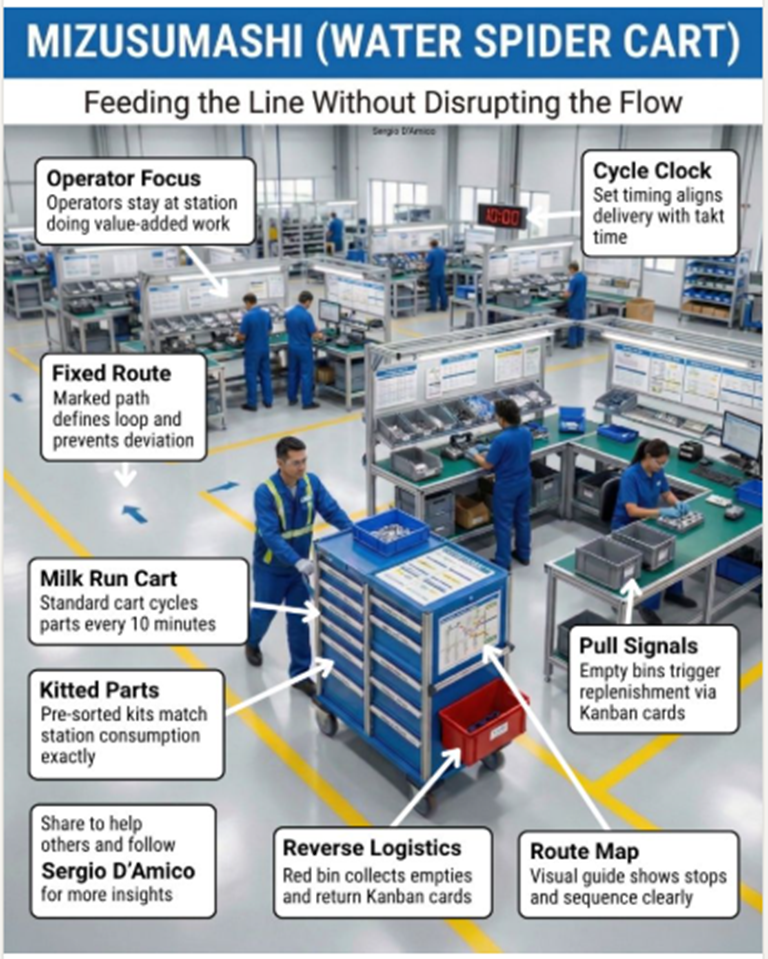
Both have similar attributes and benefits, let us learn more about Water Spiders.
Mizusumashi is one of the simplest ways to protect flow.
That is exactly why many plants use it every day.
Most lines struggle with one hidden problem:
Operators leave their stations.
They walk to get parts.
They break the flow.
That is where the Mizusumashi helps.
Mizusumashi means “water spider.”
It moves across the line without disruption.
It supports Just-in-Time flow.
It keeps materials moving, not people.
Here is how the system works:
Fixed Route
→ The cart follows a clear path.
→ Every stop is defined.
→ No deviation, no confusion.
Cycle Timing
→ The route follows takt time.
→ Each loop repeats on schedule.
→ Flow stays stable and predictable.
Pull Signals
→ Empty bins trigger replenishment.
→ Kanban cards guide the system.
→ Nothing moves without a signal.
Kitted Parts
→ Parts are prepared before delivery.
→ Each station gets exact needs.
→ No overstock, no shortages.
Reverse Logistics
→ Empty bins return upstream.
→ Waste leaves with each cycle.
→ The loop stays clean and ready.
Why this matters:
Better focus
→ Operators stay at their stations.
→ Time goes into value work.
→ Motion waste drops fast.
Better flow
→ Materials arrive on time.
→ Stockouts become rare.
→ The line keeps moving.
Better control
→ Inventory stays low.
→ Problems show up quickly.
→ The system becomes visible.
Better improvement
→ The route becomes a standard.
→ Teams can refine the loop.
→ That is how flow improves.
The best systems are built at the Gemba.
→ Walk the real route.
→ Watch the real timing.
→ Learn from the real flow.
This is not just a cart. It is a system that protects flow, focus, and stability.
As you get comfortable using the methodology it can be adjusted in many different manners but always with a focus to keep our Operators focused on the task they are best trained to do.
This seems simple, but actually can become complex quickly, so should you wish some assistance feel free to contact me.


Comments